
Written by Julie Kongsbak
What should a leader's AI competence profile actually look like?
19 August 2026 · By Julie Rønnebæk Kongsbak
I've spent many hours with leaders who want to get better at AI.
And something I keep coming back to is: What should a leader actually be able to do?
As a leader, you don't need to be an AI specialist. You don't need to be able to build the solutions yourself. And you don't need to be the best in the organisation at prompting.
But in my view, you need to know and be able to do enough to understand what AI makes possible. You need to see what it can mean for your own leadership and for the organisation. And you need to be able to lead the change that follows.
That's why I became quite absorbed in Digital Dogme's AI competence model when it was published.
The model describes ten AI competences within AI understanding, AI use, AI development and AI governance. And it made me ask a question that the model itself does not answer:
How should the ten competences be weighted if you are a leader?
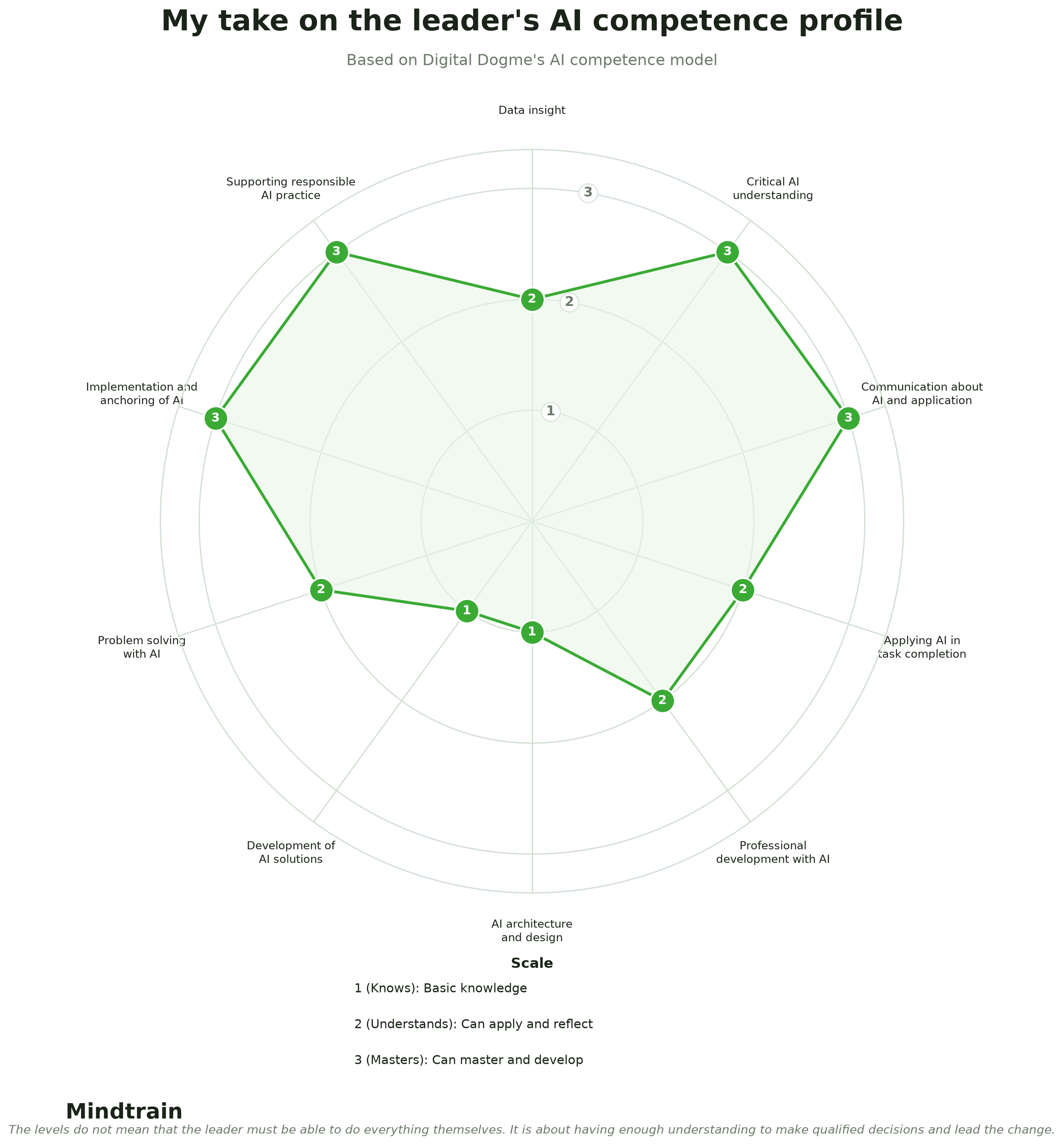
I've made my own take on it.
The leader needs different skills than the AI specialist
In my profile, the leader scores high on critical AI understanding, communication about AI, implementation and anchoring, and responsible AI practice.
By contrast, the leader does not need to master AI architecture, design and development of AI solutions.
That reflects a fairly fundamental point:
You don't necessarily need to be able to build the AI solution. But you need to be able to spot what AI can make possible.
Something I particularly notice across the competences is precisely the ability to spot the possibilities. I think of it as a kind of AI imagination.
Can you look beyond the way you solve tasks today? Can you see where AI can change quality, speed or the very way work is done? Can you imagine new possibilities, even if you don't know exactly how the technical solution should be built?
That ability appears in several places in the AI competence model. Among other things in critical AI understanding and problem solving with AI, where it's about being able to identify potential and see where AI can create value.
But of course it requires a basic understanding of AI. Because it's hard to imagine the possibilities with a technology you don't understand.
You need to get your hands on it yourself
I meet many leaders who have no ambition to become AI experts. I don't think they should either.
But I think it will be difficult to lead AI transformation if you yourself are standing on the sidelines.
Something happens when you start using AI on your own tasks. When you use it to qualify a decision, prepare a difficult conversation, investigate a problem or challenge your own thinking.
You don't just get better at the tool.
You also begin to understand why AI can do something different. Where it's strong. Where it fails. And not least, you begin to spot applications you couldn't see before you gained experience with the technology yourself.
That's the kind of AI competence development I find particularly interesting. Because understanding doesn't come only from reading or hearing about AI. It develops when you work with the technology and connect it to your own reality.
But the leader doesn't need to be able to do everything
Here I think there's an important balance.
Because if we say that the leader must both understand AI, see all the possibilities and drive innovation, we risk setting a requirement that the leader almost has to be an AI specialist on top of their leadership role.
That's not my take.
A good leader is not necessarily the person who knows the most in other areas either.
The leader needs to know enough to ask the right questions, understand the potential and make decisions on a sufficient basis. And then the leader needs to be able to bring employees' and specialists' competences into play.
That's also why I place Problem solving with AI at level 2 – Understands and not at level 3 – Masters.
The leader should be able to see possibilities and understand where AI can potentially create value. But that doesn't mean the leader themselves must be able to devise and develop all the new solutions.
And then the real leadership task begins
Once you understand the technology well enough to see the possibilities, the real leadership questions emerge.
What does AI mean for our tasks and professional domains? Where should we use it — and where should we not? What competences will employees need? What frameworks should we set? And how do we create space to experiment while also taking responsibility?
That's why I've placed implementation and anchoring, communication and responsible AI practice so high in my profile.
AI is technology. But getting it to create value in an organisation is very much a leadership task. What it means to be an AI-mature organisation is something I write about in the post on organisational AI maturity.
For me, AI-competent leadership is therefore not about knowing all the answers.
It's about understanding AI well enough to see the possibilities. Having enough experience to relate to them critically. And being enough of a leader to make decisions and set direction — even without knowing all the answers yourself.
That's my take, at least.
What does your AI competence profile look like as a leader?
/Julie